Showing posts with label beach hardening. Show all posts

6.16.2009

NC Coastal Federation's State of the Coast released

http://www.nccoast.org/publication/socreports/2009SOC

Inside, you'll find:
  • the history of beach hardening
  • how state and coastal policies encourage risky development
  • sea level rise and it's impact on NC
  • a sweeping set of recommendations to protect state beaches
  • a fitting tribute to Jim Stephenson, an excellent and thoughtful advocate for our beautiful coast, who will be sorely missed.

5.20.2009

Coastal Conversation


Last night in Chapel Hill, a bunch of scientists, former Secretaries of DENR and concerned environmental groups met to talk about the future of North Carolina's coast. Prognosis: not looking so good.

For an excellent rundown of the night's proceedings, check out this BlueNC recap. For an article explaining just what's going on, head on over to the N & O and read the article Caving in on our coast.

Most importantly, too continue the conversation held last night, the organizations involved have put together coastalconversation.com, which is intended as a public repository of all info on science-based coastal management in NC. There, folks are encouraged to answer the question: What’s your vision for what North Carolina needs to do to keep its beaches open and natural for the future?

5.07.2009

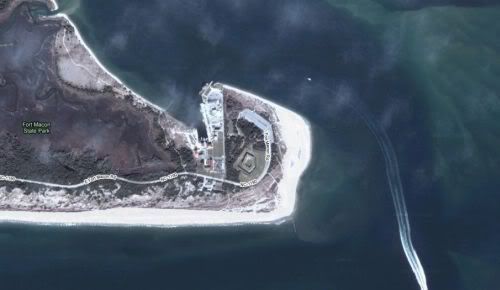
Examples of Beach Hardening in NC: Fort Macon State Park


Note the sand accumulation on the beach directly adjoining Fort Macon. With the terminal groin, natural currents are pushed further out from the shoreline, thus bypassing the beach next to the inlet. As a result, adjacent beaches must receive millions of pounds of "beach renourishment" sand (typically, in similar cases, close to every 4 years), which has been shown to impact native wildlife. The terminal groin at Fort Macon reflects the exceptions in North Carolina law that apply to areas of cultural significance.

5.06.2009

Examples of Beach Hardening in NC: Oregon Inlet


Contrary to what you might have heard, North Carolina is not the only state in the US that has a statewide ban on hardened structures. The other: Oregon.

So why not talk about Oregon Inlet (in NC, along the Outer Banks) that separates Pea Island from Bodie Island.

From an article on last session's bill (SB599) published in 2008 in the N & O:
The terminal groin built in 1992 at Oregon Inlet to protect the Bonner Bridge, for example, has required a total of 8 million cubic yards of sand to combat downdrift beach erosion along the Pea Island National Wildlife Refuge. The erosion rate continues at a pace faster than before this erosion control structure was built [emphasis mine].
And there's also this gem, from this 2008 post to the Progressive Pulse:
Promoters argue that the terminal groin will not create problems, which is not true. The very phrase “terminal groin” is a lie of Baron Munchausen proportions! It was a term first used incorrectly at Oregon Inlet to avoid the inflammatory word "jetty" after a long nationally- prominent societal battle over jetty construction. After 25 years' worth of evidence had accumulated indicating that building a jetty at Oregon Inlet wouldn’t work, the state said, “We're not building a jetty – we're building a terminal groin.” And just as predicted, the 3000-foot Oregon Inlet jetty has created immense and very costly erosion problems.

Examples of Beach Hardening in NC: Fort Fisher


SB 832 is causing a lot of worries at the coast (forum at the Wilmington Star News). Proponents of the bill are characterizing it as a modest change in state law to help coastal communities facing erosion. Not so.

Importantly, the law already recognizes limited exceptions may be needed to stabilize commercial navigational channels of regional significance (Beaufort Inlet, Cape Fear Inlet and Oregon Inlet); erosion threatened bridges (Bonner Bridge); and historic sites of national significance (Fort Fisher and Fort Macon).

But even these projects have since caused problems downdrift from the structure. Take this passage about Fort Fisher, from Exploring North Carolina's Natural Areas by UNC Press. The passage was authored by Dirk Frankenberg, of the Marine Sciences Program at UNC-Chapel Hill:

The aquarium's hurricane flood tower should be kept in mind as you drive down the exit road and see the tall (and to my eye, incredibly ugly) sand barricade bulldozed to protect the bathhouse parking lot and US 421 south of Fort Fisher State Park. This sand pile was made necessary by beach retreat on the south side of a beach-hardening project designed to protect Fort Fisher's seaward ramparts from shorefront erosion...if you want to see what happens to beaches downstream of erosion control structures, park at the bathhouse and walk out on the beach to the north. There you will see the stone erosion control structure with the beach about 200 to 500 feet back from its prestructure location. Publicly owned beach and dune have been eroded away, perhaps in a justifiable trade for protected ramparts, but only time will tell the full environmental cost of the deal.

4.30.2009

New Jersey Beaches, anyone?

Image courtesy of Len Pietrafesa: Groins built at right angles to the shore at Cape May, New Jersey, ostensibly to slow the migration of sand. The groins interrupt the flow of longshore currents, so sand is trapped on their upcurrent sides. This view is toward the south, and south of the groins, on the downcurrent sides. The effect of the groins is that sand is eroded away from the beaches.

We've blogged this before. Unfortunately, when it comes to coastal management, it's like a broken record over at the General Assembly. Even though scientists, environmental groups, and the state environmental agency DENR have expressed opposition to the use of "hardened" structures - jetties, sea walls, terminal groins - on the North Carolina coast, the indecent proposal comes up year after year.

The most recent legislation, SB 832, just passed out of the Senate.

Let's review:
  • Jetties and groins beget more jetties and groins (take a look at the picture)
  • Hardened structures protect buildings where they are located, but exponentially increase erosion on adjacent properties or islands.
  • We manage our beaches pretty well here in NC. SB 832 will punch a hole in our sound, science-based coastal management policies.
  • We need a more comprehensive look at how to deal with sea level rise, especially in light of climate change projections for the coast (interactive sea level map, EPA 2030 projections). We need beach management that doesn't reflexively call for hardened structures.

The natural beauty and economic value of North Carolina’s public beaches and inlets exists today in large measure because our state leaders long ago adopted a conservative management policy that bans the use of hardened structures—seawalls, jetties and groins of any kind—from our coast.

2.17.2009

(De)Stabilized Beaches?

Beautiful beaches like this one could be undermined by so-called stabilization projects.In 1979, erosion control structures first became regulated in NC; the initial regulations prohibited hardened structures for new developments, but those already in place could remain. But the ban changed in 1985. From that point on, all permanent erosion control devices were prohibited. Even the old ones had to go.

North Carolina’s policies against beach hardening have been (and are) frequently challenged, but state policies have gained broad public support and national recognition as responsible and far-sighted. Despite numerous attempts at eradicating the hardened structures ban, it survived well into the mid-1990’s and remained so popular that it passed into law in North Carolina General Statute 113A-115.1.

Currently, our state's beaches are having a tough time. As Duke Professor Emeritus Orrin Pilkey explains in the Fayetteville Observer:

North Carolina’s beaches face a lot of problems, including overdevelopment, rising sea level, rapid erosion rates, and a paucity of beach-compatible sand for beach replenishment...There is unanimous agreement among N.C. coastal geologists that mining of inlets, and groin or jetty emplacement, will likely create more problems than they solve. But our message is viewed by developers and politicians as negative, one that stands in the way of progress.
In a letter sent to NC legislators in the 2008 short session that opposed Senate Billl 599, which in theory allowed a "pilot program" of terminal groins off Figure 8 Island; practically, scientists urged regulators to look at the science; experiments have shown that that "control" technologies often damage adjacent beaches. SB 599 would have punched a sizable hole in North Carolina's science-based coastal management laws; oft-quoted and true, a common caution against beach "protection" and "renourishment" is that North Carolina doesn't want a coastline like New Jersey's. NC Sierra Club opposed SB 599 and recommends lawmakers reject any bill that threatens North Carolina’s proven, working coastal policies that prohibit beach hardening.