Showing posts with label transportation. Show all posts
9.02.2009
4.03.2009
The future of transportation: lots of riders
NC Policy Watch had a good article about the state's incoming transportation needs. We remain one of the fastest growing states in the nation, and Raleigh has usurped Austin, TX, as the location with the most transplants coming in (the city was also named America's best city for business and careers). It follows that the Triangle, the Triad, and other large urban areas should take a hard look at the success Charlotte has had with its LYNX light rail system.From the Policy Watch article:
...We need only look at the spectacular early success of Charlotte's Lynx Blue Line to see how light rail in North Carolina can take off fast, greatly exceed ridership estimates, and boost local economies by facilitating transit-oriented development. Our state legislature is now considering authority for other metro counties to finance their own rail systems. From Asheville to Wilmington-and in towns and cities across the state-we see a growing boom in greenways for biking and pedestrian connections.
Labels:
rail,
transportation
3.12.2009
The Good Transportation State
Picture this: a seamless, modern, and efficient transit system linking highways, public transportation, freight, passenger rail, and coastal ports. That’s the vision of legislation introduced this session of the North Carolina General Assembly. Legislation in both the House and Senate starts with local funding options for transit and has attracted broad support from business, economic development, and environmental interest groups.
In North Carolina, transportation-related global warming emissions are the second largest source of emissions behind electricity generation. Passage of "Congestion Relief/Intermodal Transport Fund" (HB 148 and SB 151) has a reasonable shot at success this session, primarily because, as opposed to prior legislation, these bills have a more statewide outlook.
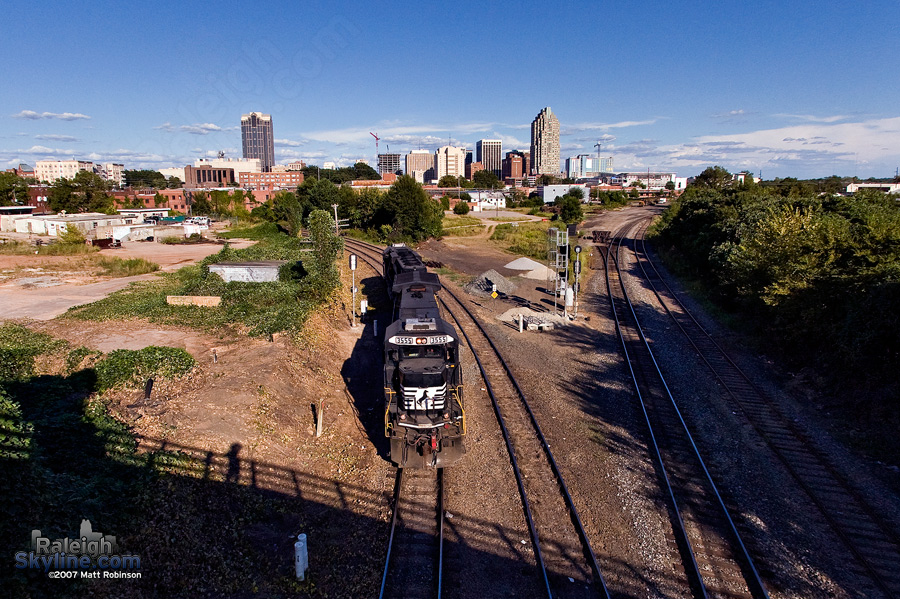
There are a lot of regional considerations, especially here in Raleigh, where project stakeholders continuously debate whether opening up the "Wye" to "light" rail (the kind of train that grabs power from an overhead line) is the right way to go, especially if further plans to connect Charlotte and Raleigh via high-speed trains are to move forward (high-speed trains need long, straight tracks to slow down, and probably wouldn't mesh easily with light-rail trains).
Despite such considerations, there is a growing consensus in the capitol that construction of more efficient public transit systems - like the LYNX in Charlotte - will a) move people more efficiently in one of the fastest growing states in the country, and b) create all kinds of jobs.
What's the hang up? Some groups are balking at what exactly "local funding options" means. In most cases, the phrase means a .5 cent increase in sales tax. In light of the huge economic downturn and state budget issues, state legislators on both sides of the aisle and city and county officials are wary to raise the sales tax for transit options that might appear years down the line. But funding options other than the sales tax hike probably wouldn't generate enough revenue.
Since the 1920’s, North Carolina has been known as the “Good Roads State.” It can and should become the “Good Transportation State” by increasing mobility, decreasing congestion and offering a robust transportation network to commuters.
In North Carolina, transportation-related global warming emissions are the second largest source of emissions behind electricity generation. Passage of "Congestion Relief/Intermodal Transport Fund" (HB 148 and SB 151) has a reasonable shot at success this session, primarily because, as opposed to prior legislation, these bills have a more statewide outlook.
There are a lot of regional considerations, especially here in Raleigh, where project stakeholders continuously debate whether opening up the "Wye" to "light" rail (the kind of train that grabs power from an overhead line) is the right way to go, especially if further plans to connect Charlotte and Raleigh via high-speed trains are to move forward (high-speed trains need long, straight tracks to slow down, and probably wouldn't mesh easily with light-rail trains).
Despite such considerations, there is a growing consensus in the capitol that construction of more efficient public transit systems - like the LYNX in Charlotte - will a) move people more efficiently in one of the fastest growing states in the country, and b) create all kinds of jobs.
What's the hang up? Some groups are balking at what exactly "local funding options" means. In most cases, the phrase means a .5 cent increase in sales tax. In light of the huge economic downturn and state budget issues, state legislators on both sides of the aisle and city and county officials are wary to raise the sales tax for transit options that might appear years down the line. But funding options other than the sales tax hike probably wouldn't generate enough revenue.
Since the 1920’s, North Carolina has been known as the “Good Roads State.” It can and should become the “Good Transportation State” by increasing mobility, decreasing congestion and offering a robust transportation network to commuters.
Labels:
transportation
1.27.2009
Clean Cars Coming to NC?

President Obama’s move Monday to allow states to set vehicle emission standards may be a breath of fresh air–quite literally– for North Carolina, where an estimated 40 percent of smog-forming emissions and 34 percent of global warming emissions in our air comes from cars and trucks.
In a sweeping set of directives, President Barack Obama acted aggressively to address global warming and modernize the ailing domestic auto industry by ordering quick action on increased fuel-efficiency standards and swift review of the long-standing request of California and 14 other states for permission to put in place stricter tailpipe standards to reduce global warming emissions.
As of now– once federal permission is granted– 15 states are poised to enjoy cleaner air by virtue of having enacted legislation adopting tailpipe standards that are more stringent than current federal regulations. There’s no longer any reason for North Carolina not to be among that group.
In 2002, North Carolina proudly passed the Clean Smokestacks bill, which addressed air pollution from coal-fired power plants. At the 2002 Governors’ Summit on Air Quality in Charlotte, then Governor Mike Easley said it was time now to clean up the cars. “We have to remember we all came here riding in our own little smokestacks,” he said.
Legislation has previously been introduced in the North Carolina General Assembly that would have our state join the growing number of others states seeking cleaner emission standards, but legislators took a wait and see approach to how EPA would respond to the request of other states for a federal waiver.
Legislators may find of interest a recent NC Division of Air Quality report showing that adopting the California clean car standard would reduce global warming pollution 40% over and beyond the benefits of increased federal fuel economy standards. That’s good news for a state found to be among the most vulnerable in the nation to the adverse impacts of global warming.
The national winds are blowing in favor of cleaning up global warming pollution from cars and trucks. The question now is– will North Carolina join other future-minded states and adopt clean cars legislation?
Labels:
emissions,
transportation
12.16.2008
Sierra Club Volunteer on Raleigh's Comprehensive Plan
Responding to Raleigh's Comprehensive Plan
by Marvin Woll, Capital Group
The City of Raleigh recently introduced the Raleigh Comprehensive Plan for 2030. A large number of Raleigh citizens and city employees did an excellent job in developing this plan. It is a good plan; however, there are some sections that need to be revised.
In the section entitled Element C: Environmental Protection there is Policy EP 7 that calls on the city to "Increase the use of renewable energy to meet 10 percent of Raleigh's peak electric load". This is a section we need to respond to and change. We should be able to meet 30 percent of Raleigh's peak electric load with renewable energy by the year 2030.
In the section entitled Element B: Transportation there is B.2.4 which concerns Public Transportation. Action T25 mentions providing fixed guideway transit services within "10 to 15 years". Raleigh has been waiting a long time to develop a light rail system and we should change the timeline on this action section to "within the next 3 to 6 years".
You can respond to the Comprehensive Plan by going to http://www.raleighplanning2030.com/. You can also provide your comments to the plan by attending one of three workshops to be held on January 13,14 and 15. Information about these workshops can also be found at the previously mentioned website.
We only have December and January to respond to this plan and make changes. Your response is vital to the process of improving the environmental and transportation sections of this plan. The future of Raleigh and our environment will depend on your actions.
by Marvin Woll, Capital Group
The City of Raleigh recently introduced the Raleigh Comprehensive Plan for 2030. A large number of Raleigh citizens and city employees did an excellent job in developing this plan. It is a good plan; however, there are some sections that need to be revised.
In the section entitled Element C: Environmental Protection there is Policy EP 7 that calls on the city to "Increase the use of renewable energy to meet 10 percent of Raleigh's peak electric load". This is a section we need to respond to and change. We should be able to meet 30 percent of Raleigh's peak electric load with renewable energy by the year 2030.
In the section entitled Element B: Transportation there is B.2.4 which concerns Public Transportation. Action T25 mentions providing fixed guideway transit services within "10 to 15 years". Raleigh has been waiting a long time to develop a light rail system and we should change the timeline on this action section to "within the next 3 to 6 years".
You can respond to the Comprehensive Plan by going to http://www.raleighplanning2030.com/. You can also provide your comments to the plan by attending one of three workshops to be held on January 13,14 and 15. Information about these workshops can also be found at the previously mentioned website.
We only have December and January to respond to this plan and make changes. Your response is vital to the process of improving the environmental and transportation sections of this plan. The future of Raleigh and our environment will depend on your actions.
Labels:
energy efficiency,
sierrans,
transportation
10.17.2008
How much CO2 is produced when you go to work?
The World Watch Institute has "tracked" the estimated carbon emissions per passenger-mile traveled (grams of CO2):
Automobile...................... 130-390
Commercial jetliner.......... 180-280
Bus................................. 110-190
Train.............................. 100-180
Walking (if all calories came from...)
(top sirloin)................... 900-1,600
(ground beef)............... 500-1,500
(2% milk)..................... 200-400
(apple).......................... 50-100
(typical U.S. diet............. 160
(vegan diet)..................... 30
Which path will you choose?
Automobile...................... 130-390
Commercial jetliner.......... 180-280
Bus................................. 110-190
Train.............................. 100-180
Walking (if all calories came from...)
(top sirloin)................... 900-1,600
(ground beef)............... 500-1,500
(2% milk)..................... 200-400
(apple).......................... 50-100
(typical U.S. diet............. 160
(vegan diet)..................... 30
Which path will you choose?
Labels:
Cool Cities,
emissions,
transportation
10.08.2008
Fast, Hot and Green
Attending one of Europe’s most important auto shows, the Paris Expo Porte de Versailles, were various hybrid and solar powered vehicles. One vehicle touts zero emissions with a hydrogen fed fuel cell. Other hybrid vehicles combine diesel gas with hydroelectricity or are completely battery powered. An adorable car, designed to look like a water droplet, took the rain cistern idea to heart. While driving it collects water, filters it, and offers it to the driver in a water bottle. Check out more of these concept cars at Paris Expo Porte de Versailles on MSN.com.
Labels:
Cool Cities,
solar power,
transportation
7.07.2008
Wake County Transit Forum
On June 26, along with several other progressive organizations, the Capital Group hosted several presentations on the future of transit in the Triangle at the Wake County Transit Forum.
You can check out the streaming video here.
Labels:
capital group,
transportation
Subscribe to:
Posts (Atom)