5.27.2009

PCS Phosphate Mine on the Pamlico


Above, you'll see photos our State Director took from above the current mining operation and the proposed area.
North Carolinians who value the remarkable natural heritage surrounding the Albermarle-Pamlico Sound are looking to EPA to protect valuable wetlands and primary fish habitat after the Army Corps of Engineers failed to intervene in a planned expansion by PCS Phosphate of a mining operation in Eastern North Carolina. At stake are 4000 acres of wetlands and nearly five miles of tidal creeks and streams, including designated primary fishing habitat, along the Pamlico River in Beaufort County.

NC Sierra Club, represented by Southern Environmental Law Center is among the groups challenging the flawed permit issued by the NC Division of Water Quality which would allow the single largest destruction of wetlands in the state’s history.

EPA has called the impacts “unacceptable” and has elevated proposed mining expansion for national review. The question now is if EPA will exercise its authority to veto some or all of PCS’s proposal.

5.20.2009

Coastal Conversation


Last night in Chapel Hill, a bunch of scientists, former Secretaries of DENR and concerned environmental groups met to talk about the future of North Carolina's coast. Prognosis: not looking so good.

For an excellent rundown of the night's proceedings, check out this BlueNC recap. For an article explaining just what's going on, head on over to the N & O and read the article Caving in on our coast.

Most importantly, too continue the conversation held last night, the organizations involved have put together coastalconversation.com, which is intended as a public repository of all info on science-based coastal management in NC. There, folks are encouraged to answer the question: What’s your vision for what North Carolina needs to do to keep its beaches open and natural for the future?

5.14.2009

No plastic bags on Outer Banks


North Carolina took an important step forward this week towards phasing out plastic bags. Sen. Josh Stein’s (D-Wake) bill - No plastic bags on Outer Banks - bans plastic bags on the Outer Banks except for some very limited uses. The NC Senate approved the measure by a vote of 49-1. It's now headed to the House.

The Outer Banks - and coastal North Carolina - provide critical habitat to many species of shore birds and sea turtles (pictured above, the critically endangered Kemps Ridley, which recently started frequenting NC beaches). Loggerhead sea turtles typically breed on Cape Hatteras, but Green sea turtles, Atlantic Ridleys, and Atlantic Hawksbill have also been spotted frequenting our shores. In the water, plastic bags mimic the appearance of jelly fish, a favorite of marine life:

It has been estimated that over a million birds and 100,000 marine animals, including mammals and turtles, die each year from plastic debris.

It's a good move by the Senate, and one that will see a lot less junk ending up in our waters. And it will cut down on wasteful, unnecessary use of petroleum.

For context: According to the Wall Street Journal, Americans use about 100 million plastic bags each year—most of which end up in landfills. Sierra Club estimates that 11 million barrels of oil are needed to produce one ton of plastic grocery bags.

5.07.2009

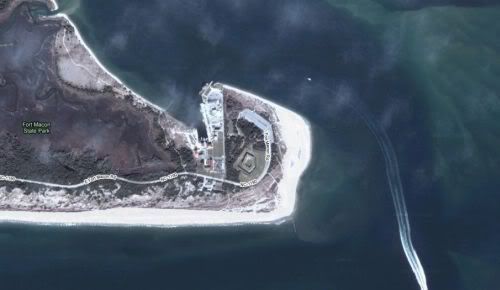
Examples of Beach Hardening in NC: Fort Macon State Park


Note the sand accumulation on the beach directly adjoining Fort Macon. With the terminal groin, natural currents are pushed further out from the shoreline, thus bypassing the beach next to the inlet. As a result, adjacent beaches must receive millions of pounds of "beach renourishment" sand (typically, in similar cases, close to every 4 years), which has been shown to impact native wildlife. The terminal groin at Fort Macon reflects the exceptions in North Carolina law that apply to areas of cultural significance.

5.06.2009

Examples of Beach Hardening in NC: Oregon Inlet


Contrary to what you might have heard, North Carolina is not the only state in the US that has a statewide ban on hardened structures. The other: Oregon.

So why not talk about Oregon Inlet (in NC, along the Outer Banks) that separates Pea Island from Bodie Island.

From an article on last session's bill (SB599) published in 2008 in the N & O:
The terminal groin built in 1992 at Oregon Inlet to protect the Bonner Bridge, for example, has required a total of 8 million cubic yards of sand to combat downdrift beach erosion along the Pea Island National Wildlife Refuge. The erosion rate continues at a pace faster than before this erosion control structure was built [emphasis mine].
And there's also this gem, from this 2008 post to the Progressive Pulse:
Promoters argue that the terminal groin will not create problems, which is not true. The very phrase “terminal groin” is a lie of Baron Munchausen proportions! It was a term first used incorrectly at Oregon Inlet to avoid the inflammatory word "jetty" after a long nationally- prominent societal battle over jetty construction. After 25 years' worth of evidence had accumulated indicating that building a jetty at Oregon Inlet wouldn’t work, the state said, “We're not building a jetty – we're building a terminal groin.” And just as predicted, the 3000-foot Oregon Inlet jetty has created immense and very costly erosion problems.

Examples of Beach Hardening in NC: Fort Fisher


SB 832 is causing a lot of worries at the coast (forum at the Wilmington Star News). Proponents of the bill are characterizing it as a modest change in state law to help coastal communities facing erosion. Not so.

Importantly, the law already recognizes limited exceptions may be needed to stabilize commercial navigational channels of regional significance (Beaufort Inlet, Cape Fear Inlet and Oregon Inlet); erosion threatened bridges (Bonner Bridge); and historic sites of national significance (Fort Fisher and Fort Macon).

But even these projects have since caused problems downdrift from the structure. Take this passage about Fort Fisher, from Exploring North Carolina's Natural Areas by UNC Press. The passage was authored by Dirk Frankenberg, of the Marine Sciences Program at UNC-Chapel Hill:

The aquarium's hurricane flood tower should be kept in mind as you drive down the exit road and see the tall (and to my eye, incredibly ugly) sand barricade bulldozed to protect the bathhouse parking lot and US 421 south of Fort Fisher State Park. This sand pile was made necessary by beach retreat on the south side of a beach-hardening project designed to protect Fort Fisher's seaward ramparts from shorefront erosion...if you want to see what happens to beaches downstream of erosion control structures, park at the bathhouse and walk out on the beach to the north. There you will see the stone erosion control structure with the beach about 200 to 500 feet back from its prestructure location. Publicly owned beach and dune have been eroded away, perhaps in a justifiable trade for protected ramparts, but only time will tell the full environmental cost of the deal.

5.01.2009

Road to Nowhere, Revisited


Lying in the Southern Appalachians, the Great Smoky Mountains National Park is a World Heritage Site for its diversity of wildlife and its temperate deciduous forests. 60+ years ago, the federal government promised Swain County a road connecting Bryson City with the north shore of Fontana Lake to replace a route flooded during the creation of Fontana Lake. Doing so would have cut a permanent, deep gash through the roadless mountain tract - the largest in federal ownership in the Eastern United States - home to songbirds, bear, deer, and elk.

But it would have been worse. Large veins of phyritic rock, which produces sulfuric acid when exposed to the air, would be disturbed during construction. Acidic runoff would devastate fish and salamander populations. In short, the road would have forever altered the world's most biologically diverse temperate zone.

A recent article in the Citizen-Times explores the history of the park. In that article, long time Sierra Club conservation activist Ted Snyder has this to say about the park:
Ted Snyder...said the cash settlement was the right decision.

Snyder said the fact the park service was open to discussion about building a road through the Smokies doesn't bode well for the park's next 75 years.

“They should have said ‘Here's our stand, we are not going to have a North Shore Road,'” he said. “They put on the false face of being neutral when they have no...business being neutral.”
In late 2007, Congress passed an omnibus Appropriations bill that included $6 million for Swain County. The Secretary of the Interior, the Swain County Commission, the North Carolina Governor's Office and the Tennessee Valley Authority, all of whom signed the original North Shore agreement in 1943, are scheduled to amend the original agreement before Swain County can receive funds.