Showing posts with label coastal management. Show all posts

11.19.2009

Last day to comment on Titan Cement

Along the banks of the mercury impaired Northeast Cape Fear River, Titan America plans to build the fourth-largest cement plant and limestone mine in the country. Proposed emissions: over 140 hazardous and toxic air pollutants including mercury, particulate matter, nitrogen oxide (NOx), and sulfur dioxide.

That's all in the draft air permit, over which the public comment period ends today. Inextricably linked with the public health and water quality issues is the rapid pace the state has taken with the permitting process.

As our Cape Fear group chair wrote back in September, normally a project of similar size and scope would trigger the NC Environmental Policy Act (SEPA). SEPA is triggered when the following conditions are met: (1) state permitting is needed for the project (2) the project will have significant environmental impact, and (3) public money has been accepted by the company. All conditions seem to apply to the proposed cement kiln in Wilmington. Titan has claimed that though they accepted $4,000,000 in public money, it doesn't apply to Point 3 because the funds are technically a reduction in taxes after the project is completed. The North Carolina Department of Environment and Natural Resources (DENR) originally determined that SEPA applied, but subsequently rescinded.

And there's more, of course. The US EPA currently has draft rules w/r/t emissions from cement kilns, and the maximum limit laid out in those rules would be exceeded by the permit granted to Titan America by the state of North Carolina. As the Charlotte Observer put it: "The state has put the cart ahead of the horse..."

Update: In a letter dated November 18, 2009, Joe Sinsheimer asked Governor Perdue for "a 90-day freeze on the Titan Cement environmental permitting process," among other things. You can read the letter and analysis at the News & Observer. In an interview, the Governor stated in response that she would look into Sinsheimer's concerns, and said specifically regarding Titan Cement: “I have asked the attorney general’s office, the SBI, to see if there was any kind of — I don’t know the word, I’m not a lawyer — if there was anything that wasn’t aboveboard in the decision making, and I believe they will.”

7.21.2009

Our own Atlantic garbage patch?


The Great Pacific garbage patch gets all the press, but we have our own swirling sea of refuse and plastic debris - sort of. Take a boat just past the Gulf Stream off our coast and you'll enter the North Atlantic Gyre, which is quickly gaining notoriety for trashiness.

A UNCW staffer is headed out to investigate, map, and chronicle the Sargasso Sea's increasing likeness to a landfill, and you can follow her exploits here: the Plastic Ocean.

From their website:

UNCW’s Bonnie Monteleone and Jennifer O’Keefe, Director of Keep America Beautiful- New Hanover County, will represent North Carolina’s passion for the ocean by going out into the Atlantic Gyre, followed by Monteleone joining Algalita Marine Research Foundation into the North Pacific Gyre. They will be taking samples to quantify pelagic plastics found on the oceans surface, collecting surface feeding fish to necropsy for ingested plastics and bringing national awareness to the issues of man made debris entering our oceans.

7.09.2009

On Behalf of the Cape Fear Group


SEPA is the State Environmental Policy Act and it is rarely triggered, but it needs to be for Titan Cement. It ensures that permits are not granted piecemeal, but that all relevant agencies will have their concerns heard before any permits are granted.

SEPA is triggered when the following conditions are met: (1) state permitting is needed for the project (2) the project will have significant environmental impact, and (3) public money has been accepted by the company. All of these conditions apply to Titan.

Titan doesn't want SEPA and is saying that even though they accepted $4,000,000 in public money, it doesn't apply because technically it is a reduction in taxes after the project is completed. DENR originally determined that SEPA applied, but has since decided that it does not. Titan has at least eight lobbyists in Raleigh working to get their air permit , and we need people from across the state to call Governor Perdue and insist that this project must still be subject to SEPA review. No air permit should be granted until all state agencies have had an opportunity to state their concerns.

Her number in Raleigh is 919-733-5811.

But she needs to hear from citizens across the state. Regional Governor's office numbers are:
New Bern: 252-514-4825
Asheville: 828-251-6160
Charlotte: 704-330-5290

Thank you for your help -- if you have any questions, please email me or call me 910-313-0498.

Janice Wilson
Chair, Cape Fear Group

6.26.2009

Plastic Bags Banned from OBX

http://projects.newsobserver.com/under_the_dome/bill_in_a_banned_bag

Gov. Beverly Perdue signed legislation Wednesday that bans plastic shopping bags for large retailers on the Outer Banks and sent the new law back to its chief patron, Senate President Pro Tem Marc Basnight, in -- wait for it -- a plastic shopping bag.

6.03.2009

Smartersafer.org


SmarterSafer is a diverse coalition of consumer advocacy, taxpayer, environmental and insurance industry groups that has joined together to raise concerns about natural catastrophe legislation being considered in Congress. We also advocate responsible legislation that gives homeowners incentives for, and assistance in, protecting their homes.

Coalition members strongly support measures pending in Congress that would encourage and assist homeowners in taking mitigation steps to protect their homes against hurricanes. These include bills to create a new hurricane mitigation tax credit, as well as a new loan program that would provide low-interest loans to homeowners undertaking risk mitigation. A big part of the effort is not turning natural disasters into financial disasters. Sign the petition.

5.20.2009

Coastal Conversation


Last night in Chapel Hill, a bunch of scientists, former Secretaries of DENR and concerned environmental groups met to talk about the future of North Carolina's coast. Prognosis: not looking so good.

For an excellent rundown of the night's proceedings, check out this BlueNC recap. For an article explaining just what's going on, head on over to the N & O and read the article Caving in on our coast.

Most importantly, too continue the conversation held last night, the organizations involved have put together coastalconversation.com, which is intended as a public repository of all info on science-based coastal management in NC. There, folks are encouraged to answer the question: What’s your vision for what North Carolina needs to do to keep its beaches open and natural for the future?

5.14.2009

No plastic bags on Outer Banks


North Carolina took an important step forward this week towards phasing out plastic bags. Sen. Josh Stein’s (D-Wake) bill - No plastic bags on Outer Banks - bans plastic bags on the Outer Banks except for some very limited uses. The NC Senate approved the measure by a vote of 49-1. It's now headed to the House.

The Outer Banks - and coastal North Carolina - provide critical habitat to many species of shore birds and sea turtles (pictured above, the critically endangered Kemps Ridley, which recently started frequenting NC beaches). Loggerhead sea turtles typically breed on Cape Hatteras, but Green sea turtles, Atlantic Ridleys, and Atlantic Hawksbill have also been spotted frequenting our shores. In the water, plastic bags mimic the appearance of jelly fish, a favorite of marine life:

It has been estimated that over a million birds and 100,000 marine animals, including mammals and turtles, die each year from plastic debris.

It's a good move by the Senate, and one that will see a lot less junk ending up in our waters. And it will cut down on wasteful, unnecessary use of petroleum.

For context: According to the Wall Street Journal, Americans use about 100 million plastic bags each year—most of which end up in landfills. Sierra Club estimates that 11 million barrels of oil are needed to produce one ton of plastic grocery bags.

5.07.2009

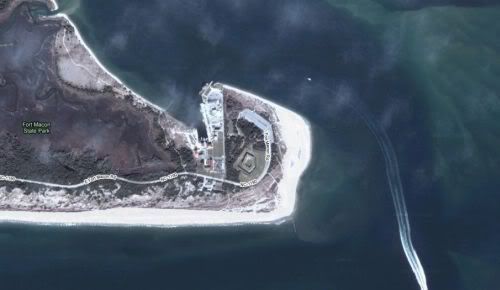
Examples of Beach Hardening in NC: Fort Macon State Park


Note the sand accumulation on the beach directly adjoining Fort Macon. With the terminal groin, natural currents are pushed further out from the shoreline, thus bypassing the beach next to the inlet. As a result, adjacent beaches must receive millions of pounds of "beach renourishment" sand (typically, in similar cases, close to every 4 years), which has been shown to impact native wildlife. The terminal groin at Fort Macon reflects the exceptions in North Carolina law that apply to areas of cultural significance.

5.06.2009

Examples of Beach Hardening in NC: Oregon Inlet


Contrary to what you might have heard, North Carolina is not the only state in the US that has a statewide ban on hardened structures. The other: Oregon.

So why not talk about Oregon Inlet (in NC, along the Outer Banks) that separates Pea Island from Bodie Island.

From an article on last session's bill (SB599) published in 2008 in the N & O:
The terminal groin built in 1992 at Oregon Inlet to protect the Bonner Bridge, for example, has required a total of 8 million cubic yards of sand to combat downdrift beach erosion along the Pea Island National Wildlife Refuge. The erosion rate continues at a pace faster than before this erosion control structure was built [emphasis mine].
And there's also this gem, from this 2008 post to the Progressive Pulse:
Promoters argue that the terminal groin will not create problems, which is not true. The very phrase “terminal groin” is a lie of Baron Munchausen proportions! It was a term first used incorrectly at Oregon Inlet to avoid the inflammatory word "jetty" after a long nationally- prominent societal battle over jetty construction. After 25 years' worth of evidence had accumulated indicating that building a jetty at Oregon Inlet wouldn’t work, the state said, “We're not building a jetty – we're building a terminal groin.” And just as predicted, the 3000-foot Oregon Inlet jetty has created immense and very costly erosion problems.

Examples of Beach Hardening in NC: Fort Fisher


SB 832 is causing a lot of worries at the coast (forum at the Wilmington Star News). Proponents of the bill are characterizing it as a modest change in state law to help coastal communities facing erosion. Not so.

Importantly, the law already recognizes limited exceptions may be needed to stabilize commercial navigational channels of regional significance (Beaufort Inlet, Cape Fear Inlet and Oregon Inlet); erosion threatened bridges (Bonner Bridge); and historic sites of national significance (Fort Fisher and Fort Macon).

But even these projects have since caused problems downdrift from the structure. Take this passage about Fort Fisher, from Exploring North Carolina's Natural Areas by UNC Press. The passage was authored by Dirk Frankenberg, of the Marine Sciences Program at UNC-Chapel Hill:

The aquarium's hurricane flood tower should be kept in mind as you drive down the exit road and see the tall (and to my eye, incredibly ugly) sand barricade bulldozed to protect the bathhouse parking lot and US 421 south of Fort Fisher State Park. This sand pile was made necessary by beach retreat on the south side of a beach-hardening project designed to protect Fort Fisher's seaward ramparts from shorefront erosion...if you want to see what happens to beaches downstream of erosion control structures, park at the bathhouse and walk out on the beach to the north. There you will see the stone erosion control structure with the beach about 200 to 500 feet back from its prestructure location. Publicly owned beach and dune have been eroded away, perhaps in a justifiable trade for protected ramparts, but only time will tell the full environmental cost of the deal.

4.30.2009

New Jersey Beaches, anyone?

Image courtesy of Len Pietrafesa: Groins built at right angles to the shore at Cape May, New Jersey, ostensibly to slow the migration of sand. The groins interrupt the flow of longshore currents, so sand is trapped on their upcurrent sides. This view is toward the south, and south of the groins, on the downcurrent sides. The effect of the groins is that sand is eroded away from the beaches.

We've blogged this before. Unfortunately, when it comes to coastal management, it's like a broken record over at the General Assembly. Even though scientists, environmental groups, and the state environmental agency DENR have expressed opposition to the use of "hardened" structures - jetties, sea walls, terminal groins - on the North Carolina coast, the indecent proposal comes up year after year.

The most recent legislation, SB 832, just passed out of the Senate.

Let's review:
  • Jetties and groins beget more jetties and groins (take a look at the picture)
  • Hardened structures protect buildings where they are located, but exponentially increase erosion on adjacent properties or islands.
  • We manage our beaches pretty well here in NC. SB 832 will punch a hole in our sound, science-based coastal management policies.
  • We need a more comprehensive look at how to deal with sea level rise, especially in light of climate change projections for the coast (interactive sea level map, EPA 2030 projections). We need beach management that doesn't reflexively call for hardened structures.

The natural beauty and economic value of North Carolina’s public beaches and inlets exists today in large measure because our state leaders long ago adopted a conservative management policy that bans the use of hardened structures—seawalls, jetties and groins of any kind—from our coast.

2.17.2009

(De)Stabilized Beaches?

Beautiful beaches like this one could be undermined by so-called stabilization projects.In 1979, erosion control structures first became regulated in NC; the initial regulations prohibited hardened structures for new developments, but those already in place could remain. But the ban changed in 1985. From that point on, all permanent erosion control devices were prohibited. Even the old ones had to go.

North Carolina’s policies against beach hardening have been (and are) frequently challenged, but state policies have gained broad public support and national recognition as responsible and far-sighted. Despite numerous attempts at eradicating the hardened structures ban, it survived well into the mid-1990’s and remained so popular that it passed into law in North Carolina General Statute 113A-115.1.

Currently, our state's beaches are having a tough time. As Duke Professor Emeritus Orrin Pilkey explains in the Fayetteville Observer:

North Carolina’s beaches face a lot of problems, including overdevelopment, rising sea level, rapid erosion rates, and a paucity of beach-compatible sand for beach replenishment...There is unanimous agreement among N.C. coastal geologists that mining of inlets, and groin or jetty emplacement, will likely create more problems than they solve. But our message is viewed by developers and politicians as negative, one that stands in the way of progress.
In a letter sent to NC legislators in the 2008 short session that opposed Senate Billl 599, which in theory allowed a "pilot program" of terminal groins off Figure 8 Island; practically, scientists urged regulators to look at the science; experiments have shown that that "control" technologies often damage adjacent beaches. SB 599 would have punched a sizable hole in North Carolina's science-based coastal management laws; oft-quoted and true, a common caution against beach "protection" and "renourishment" is that North Carolina doesn't want a coastline like New Jersey's. NC Sierra Club opposed SB 599 and recommends lawmakers reject any bill that threatens North Carolina’s proven, working coastal policies that prohibit beach hardening.